Why Google Ads is still the intent engine in 2026 for local services, e-commerce and B2B
By The Maplecrest Growth team · February 10, 2026 · 7 min read
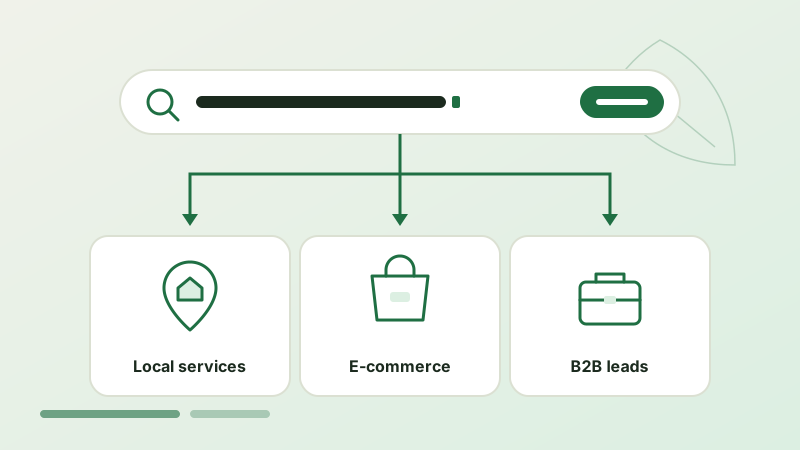
Every year someone declares search advertising finished. In 2026 the candidates are AI answers at the top of the results page, short video everywhere, and a cost per click that keeps rising in most categories. And yet when a homeowner's furnace quits in January, a shopper wants a specific pair of running shoes by Friday, or an operations manager needs a vendor for a problem the board noticed last week, the first move is still the same. They type what they need into Google. That typed need is what makes Google Ads different from every other channel, and it is why we have built our agency around it since 2021.
What changed, and what did not
Three things have changed meaningfully. First, the results page is busier. AI Overviews and AI Mode answer many informational questions directly, so ads on "how to" and "what is" queries see fewer clicks than they used to. Second, the platform is far more automated. Smart Bidding sets the bid in every auction, broad match interprets the keyword, Performance Max assembles the ad from your assets, and AI Max for Search extends a campaign to queries you never typed. Third, measurement has moved to a consented, modeled world. Enhanced conversions, consent mode v2 and GA4 fill the gaps that third-party cookies used to cover.
What has not changed is the intent. Commercial queries, the ones with a service, a product, a location or the words "near me" in them, still mean someone is ready to act. Google still shows ads above those results, still charges only for the click, and still lets you choose which queries you want to appear on and which you do not. No feed-based platform offers that combination. The channel is harder to run well than it was five years ago. It is not less valuable. If anything, the gap between a well-run account and a neglected one has widened, because automation amplifies whatever you feed it.
Local services: the phone still rings from Search
For a plumber, roofer, electrician, dentist or personal injury attorney, the winning play has barely moved. Search campaigns on exact and phrase match for the services you actually want to sell, a tight geography, a landing page with a tap-to-call button, and call tracking so you know which keyword made the phone ring. In 2026 the stack has two useful additions. Local Services Ads put a verified listing at the very top of the page and charge per lead rather than per click, which suits emergency and repair services where the call is the conversion. And Smart Bidding on calls and form fills, fed by call tracking and enhanced conversions for leads, lets a small account hold a target cost per lead without constant manual bid work.
The mistake we see most often in local accounts is leaving broad match and Performance Max unfenced. A broad match keyword for "ac repair" will happily spend on "ac repair jobs" and "how to fix ac yourself" until the negative keyword lists catch up. The second mistake is tracking only form fills when most of the real leads are phone calls.
E-commerce: the feed is the campaign
Online stores live in Shopping. Product listings with an image, a price and a merchant name appear above text ads for almost every product query, and in 2026 they run through two campaign types. Standard Shopping gives you control over bids and product groups. Performance Max with a Merchant Center feed lets Google decide placement across Search, Shopping, YouTube, Display, Discover, Gmail and Maps. Both depend entirely on the feed. Titles that lead with what people search for, correct GTINs and product types, accurate price and availability, and custom labels that separate best sellers from clearance determine how often you appear and whether the click is worth paying for.
The 2026 nuance is brand control. Performance Max will take credit for branded searches that would have converted anyway unless you add brand exclusions and campaign-level negative keywords. Set them, then judge the campaign on new customer acquisition and incremental revenue rather than blended ROAS. Demand Gen, with lookalike segments built from your buyers, adds the top of the funnel once Shopping is profitable, not before.
B2B and SaaS: fewer searches, higher stakes
B2B search volumes are small and clicks are expensive, which scares some teams off. The math works when you track the right thing. A form fill is not a conversion; a qualified opportunity is. Offline conversion import, through the Google click ID or through enhanced conversions for leads using the hashed email a prospect gave you, sends CRM stages back into Google Ads so Smart Bidding optimizes toward pipeline rather than raw form volume. Once that loop exists, Search on problem, category and competitor-alternative queries becomes one of the most efficient sources of sales conversations a B2B company can buy, and the data makes it defensible to a finance team.
Pair it with responsive search ads that speak to the buyer's role and stage, and with landing pages that respect a longer decision cycle: comparison pages, pricing explainers, implementation details. Demand Gen and YouTube come later, to stay in front of a buying committee between searches. The order matters. Reach without the intent layer underneath it is expensive brand building with no way to prove it worked.
What Google Ads is not good at
Honesty keeps clients longer than optimism does. Google Ads is a poor tool for inventing demand for a product nobody searches for yet, for brands with no clear offer or no margin, and for businesses that cannot answer the phone or ship on time. It is expensive in categories where lead aggregators and national players bid aggressively, and it punishes slow, confusing landing pages twice, through Quality Score and through conversion rate. If your economics only work with a very low cost per lead and no sales process behind it, start by fixing the offer and the follow-up, not the campaign. We tell prospective clients this in the proposal, and sometimes it means we recommend waiting.
How to decide whether it fits your business
Ask three questions. Do people search for what you sell, in the words you would use, in the places you serve? Can you measure the outcome you actually want, whether that is a call over a minimum duration, a purchase with its value, or a qualified opportunity from the CRM? And can you serve the demand if it arrives next week, with staff, stock and a sales process ready?
If the answers are yes, Google Ads in 2026 is still the highest-intent channel you can buy. The remaining work is doing it properly: clean conversion tracking before the first dollar spends, a deliberate structure with exact and phrase match before broad, automation fenced with negatives and brand exclusions, and a weekly habit of reading the data and acting on it. That is less exciting than a new platform. It is also what works.
Want a straight answer about your business? Tell us what you sell and where on our contact page. We reply within one business day with questions and an honest view of whether Google Ads is the right next step, and what it would take to do it properly.