Search vs Performance Max vs Demand Gen: which to run first and how to feed them creative and signals
By The Maplecrest Growth team · July 14, 2026 · 7 min read
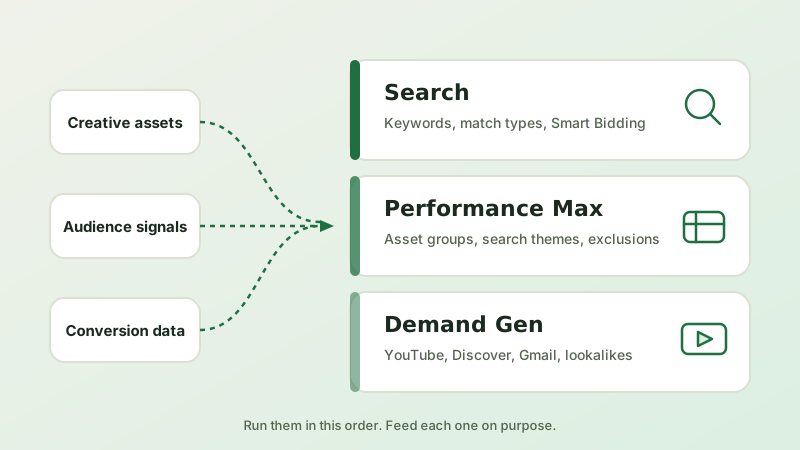
Open a new Google Ads account in 2026 and the interface will nudge you toward Performance Max within minutes. It is a capable campaign type. It is also the wrong first campaign for almost every business, because it needs two things a new account does not have: trustworthy conversion data and good creative. This article explains what Search, Performance Max and Demand Gen each do, the order that protects your budget, and how to feed each one so automation works for you rather than on you.
What each campaign type actually does
Search campaigns show text ads on Google results for keywords you choose. You control match types, negative keywords, geography and the landing page for each ad group, and the search terms report shows you most of the queries you paid for. It is the most transparent campaign type Google offers.
Performance Max takes a goal, a budget, your conversion data and a set of assets, and runs across every Google surface at once: Search, Shopping, YouTube, Display, Discover, Gmail and Maps. You organize creative into asset groups, add search themes to steer it toward query areas, provide audience signals as a starting point, and fence it with brand exclusions, campaign-level negative keywords and URL exclusions. You get channel performance reporting, asset group reporting and search terms insights, but far less detail than Search shows.
Demand Gen is the visual, audience-based campaign type. It places image and video ads in YouTube in-stream, in-feed and Shorts, in Discover and Gmail, and on the Display Network. It targets people rather than queries: your customer lists, lookalike segments built from them, in-market and affinity segments, and visitors from GA4. It creates demand instead of harvesting it, and its effect is measured over weeks rather than days.
Run Search first, and make it earn the data
Search goes first because it is the only one of the three that lets you learn with your eyes open. Every query is visible. Every negative keyword is a decision you can explain. Every conversion traces back to a keyword and an ad. In the first weeks you discover what people actually type, which services or products carry buying intent, and which landing pages convert. That knowledge becomes the search themes, audience signals and negative lists you will later hand to Performance Max.
Start on exact and phrase match for the terms you are confident in. Use maximize conversions or maximize conversion value until the campaign has enough conversions to hold a target CPA or target ROAS, then move to targets gradually. Resist broad match until there is conversion history for Smart Bidding to use; when you add it, keep it in its own ad group or campaign so you can see what it brings in. Consider AI Max for Search, Google's bundle of search term matching, text customization and final URL expansion, only after the core campaign is stable, and read its search term and asset reporting every week once it is on.
Add Performance Max when you can feed it and fence it
Performance Max earns its place when three conditions hold. The account has at least a month of clean, verified conversions, with enhanced conversions on and duplicates removed. You have real creative: a full set of headlines and descriptions, high-quality images in every required ratio, at least one video that is not a slideshow, and for retail a Merchant Center feed in good standing. And you have decided what Performance Max should not be allowed to do.
Fencing matters more than most guides admit. Add brand exclusions so it does not take credit for people already searching your name. Add campaign-level negative keywords for the junk your Search campaigns already found. Use URL exclusions or turn off final URL expansion if it sends traffic to pages that cannot convert, such as careers or support. Build asset groups around one product line or service each, so the reporting tells you something useful. For e-commerce, consider separate campaigns for best sellers and the long tail using custom labels, and set a new customer acquisition goal if growth matters more than blended efficiency. Then judge it on incremental results: conversions on non-brand queries, new customers, revenue that Search was not already producing.
Demand Gen is for demand you have to create
When Search and Shopping are capturing the intent that exists, growth means reaching people who have not started searching yet. That is Demand Gen's job. Build it on first-party audiences: customer lists uploaded with consent, website visitors and purchasers from GA4, YouTube channel engagers, and lookalike segments seeded from your best buyers rather than from everyone who ever visited. Give it video and image creative made for sound-off, vertical viewing, with the product or the outcome visible in the first second and a clear offer by the third.
Optimize toward conversions or conversion value, but measure it with patience and with more than last-click data. Its effect shows up as more branded searches, more direct traffic and higher Search conversion rates a few weeks later. Watch assisted conversions and branded query volume in the weeks after launch before deciding whether it works.
How to feed each one: creative and signals
Search eats keywords, negatives and responsive search ads. Feed it weekly with the search terms report, promote converting queries to exact match keywords, pin the headlines that carry the offer, and keep ad strength as a diagnostic rather than a goal. Give it audiences in observation mode so Smart Bidding has more signal without losing reach.
Performance Max eats assets and conversions. Feed it a complete set of text, image and video assets per asset group, replace anything that holds a "Low" performance label for more than a few weeks, keep the feed accurate, and make sure every conversion it optimizes toward is real: enhanced conversions on, duplicate actions set to secondary, and offline outcomes imported if you sell through a sales team.
Demand Gen eats audiences and video. Feed it fresh customer lists, lookalike segments rebuilt as the buyer base grows, and new creative every few weeks, because frequency on YouTube rises quickly and fatigue shows up as falling view rates.
A sequencing plan for three kinds of business
Local services: Search on service terms with call tracking, then Local Services Ads alongside it, then Performance Max for lead generation with brand exclusions and spam-resistant forms once lead quality is proven. Demand Gen only for larger multi-location brands with the creative budget to sustain it.
E-commerce: Search on brand and category terms with standard Shopping, then Performance Max with the feed once conversions and creative are ready, then Demand Gen with lookalike segments to bring in new customers once Shopping is profitable.
B2B and SaaS: Search on problem and category queries with offline conversion import in place, then Demand Gen to stay in front of accounts between searches, and Performance Max last, carefully, with tight audience signals and lead form filters.
The pattern is the same every time. Harvest intent transparently, prove the measurement, then let automation extend what you already know works.
Not sure which campaign your account should launch next? Tell us what is running today and what you sell on our contact page. We will reply within one business day with the sequence we would recommend and the data we would want to see first.